Focus Group with C6 Bank Clients
We aimed to understand the low-income audience — previously underexplored by the bank — and their financial habits, while analyzing competitors targeting this segment. This project also gave the Design team visibility in key business decisions.

Overview
This was a project carried out within C6 Bank by the Service Design team in 2020. The team was composed of four service designers, and I was one of them.We had no visibility into the low-income audience, which had been largely underexplored by the bank. We needed to understand our direct competitor and how they targeted this audience. At the same time, we were launching new financial services at a fast pace and needed to understand these people’s financial lives and daily money routines.As a Design team, we had limited visibility within the company, not participating in executive committees or key meetings that directly impacted the business. We saw this project as an opportunity to open a door.We decided to move forward with a focus group, which allowed us to understand different ways of thinking within the same context, but with varied personality profiles.
Principal Problem
Solution
-
No visibility about the direct competitor.
-
No visibility about people's financial lives.
-
As a Design team: no visibility within the executive committees and the impacted of the business.
-
A focus group aimed at understanding the financial knowledge of users of the main competitors.
-
Quantitative and qualitative research related to the financial ecosystem.
1
CSD Matrix
2
Quantitative Research
3
Qualitative Research

CSD Matrix
At this stage, the CSD Matrix was created to understand the certainties, assumptions, and doubts I had regarding the user profile, the market, and the environment, as well as to determine the path for continuing the research.
At this point, I was able to identify problems that needed to be addressed and highlight the questions to explore throughout the process.
I involved the business team, Product Owners, and the squad that was co-leading the project with us.
Quantitative Research
The research was conducted separately for the following predetermined profiles:
-
Low-income.
-
By age group.
-
Within the city of São Paulo.
-
Non-C6 Bank account holders who had an account with Nubank.
The survey was sent to 3,000 participants, with 1,000 in each group.
18 to 25 years old
343 responses
26 to 40 years old
279 responses
40 years old and above
230 responses
Important considerations
According to Federal Government rules in 2019, low-income individuals were considered those earning half a minimum wage (currently R$550) per person, and families earning up to three minimum wages.
At C6 Bank, the bank defined low income as people earning between R$1,000 and R$4,000 per month.
According to the bank’s guidelines at the time, the plan was to initially focus on the São Paulo region and later expand to other areas. The research was regional, not nationwide.
The questionnaire was divided into the following categories:
-
Motivational questions: related to what led the person to choose a particular service.
-
Comparative questions: to understand why they made that choice and the main differences between services.
We did not ask questions about region, gender, or age, as this information was already available in the CRM and BI databases.
Quantitative General Analyses
60%
of people use Nubank because of the automatic yield in their checking account
90%
of people said they like Nubank because they consider it a transparent bank with its customers
45%
of people said they prefer customer service.
65%
of people said they would love to have all their accounts and other apps they use daily in one place (super app).
22%
choose a digital bank for additional products beyond the card (insurance, loans, investments).
85%
of people responded that they intend to use both a digital bank and a traditional bank for trust reasons.
Qualitative Research
A structured script with more focused, closed-ended questions was created to understand the behavior of the people who would be interviewed. Therefore, we defined our target audience to follow the same profile as the quantitative research:
-
Low-income
-
By age group
-
Men and women
-
Within the city of São Paulo
-
Non–C6 Bank account holders who had an account with Nubank
The research was conducted in 3 groups, with 12 people in each group on different days.
18 to 25 years old
12 responses
26 to 40 years old
12 responses
40 years old and above
12 responses

Focus Group
The goal was to identify problems, areas for improvement, and moments of delight, always considering the opportunities these insights could bring to both the user and the business.Each session lasted approximately two hours and was conducted on different days. The sessions were filmed and photographed, and participants signed a media release form for this purpose.

Must have, Could have, Should have
After gathering responses from the structured questions for this stage, I introduced some interactive activities to make the session lighter and to gather additional insights before concluding.Focusing on the experience with financial apps, I listed several features from different market applications and broke them down into statements. I then asked participants to place these statements into different scenarios: the first scenario was “Must Have,” the second “Could Have,” and the third “Should Not Have.”The goal was to understand which features were essential and which were completely dispensable for these people—identifying those that truly made an impact and those that didn’t matter as much.
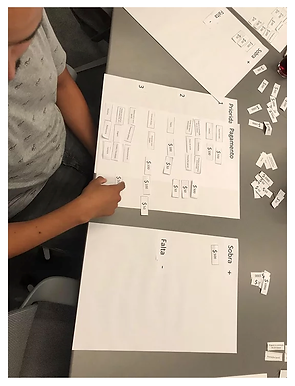
How? Where? Why and When?
In this activity, I aimed to better understand these people’s financial routines. How do they invest their money? Do they invest at all? How do they manage their money throughout the month—do they have high spending? Are they concerned with saving? How much do they save? Why save? And how do they save?I used a simple framework of How? Where? Why? and When?, which proved insightful, as many participants were often unaware of their own financial habits.
Qualitative General Analyses
Most respondents said they consider Nubank an accessible and popular bank, and because it is transparent and easy to use, they do not plan to switch anytime soon.
Most people said they do not invest because they do not understand how, but that they would consume financial education content if the bank invested in it.
People between 18 and 25 years old showed greater concern about saving money for the future.
Most people said they believe they need to save money first before starting to invest.
Everyone said they had experienced some kind of problem with a bank at some point in their lives.
Everyone said they have both a traditional and a digital bank account because they still cannot part with the traditional bank, as they believe it “handles everything.”
Learnings:
1 - This study targeted C6 Bank's low-income tier, not the actual low-income population of Brazil. We flagged this to stakeholders from day one: the results reflect a specific internal definition that doesn't match the country's reality.A true 'low-income Brazil' study would require looking at total monthly household income capped at R$4,000.00 and including people in poverty. Instead, this research focused on individuals making R$1,000.00 to R$4,000.00 without considering other family earners. This approach ignores the family unit and, frankly, misses the mark on how the low-income segment actually lives."
2 - Ethnographic and field research should have been explored. However, due to time constraints and project prioritization, we had to make strategic choices on how to approach this audience. Conducting these types of research would have been crucial to providing relevant insights for the project.
3 - The BI and CRM teams were brought in and provided relevant data to complement the research. However, we could have also leveraged tools such as Tableau and Google Analytics at the time to generate even deeper insights and supporting data.
Business Impact
Shifts in internal project priorities, favoring a deeper understanding and more comprehensive analysis of competitors within the business.An untapped business potential aimed at the 18-25 age group, as they are the most interested in future-oriented financial matters and products that can help boost and organize their financial lives.